


.gif)
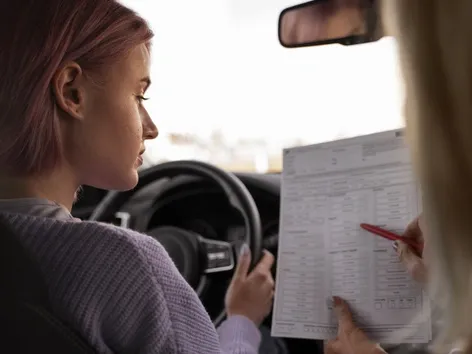
In most European countries, the penalty points system helps reduce accidents and make drivers more disciplined. Find out how penalty points work in France, Germany, Italy and Poland, which violations lead to loss of rights and how it affects insurance

Ukraine is preparing to introduce a system of penalty points for traffic violations. This practice has been successfully operating in most European Union countries for many years. Its main goal is to make roads safer, reduce the number of accidents and motivate drivers to follow the rules.
How exactly does the points system work in Europe, how many violations are allowed without losing your rights and what to expect from the Ukrainian model - we will tell you in this article.
Are you going abroad by car? Don't forget about your Green Card! At Visit Ukraine, you can choose from offers from various insurers and apply for insurance in 5 minutes.

How does the penalty point system work for drivers in Europe?
The European system is based on a simple principle: each violation of the rules has a certain “value” in points that are written off or accumulated. When a driver exceeds the established limit, he automatically loses the right to drive a vehicle.
This approach makes the system transparent and fair - decisions are made automatically, without the influence of the human factor, and drivers understand the consequences of their actions.
However, the penalty point accrual system is not uniform throughout the EU and varies depending on the country.
France
The French penalty point system has existed since 1992 and is considered one of the most effective in the EU. Each driver starts with 12 points, which are gradually removed for each violation. When the score drops to zero, the license is canceled and the driver has to take the exam again.
The number of points that can be lost depends on the violations:
- Talking on the phone while driving - minus 2 points;
- Driving without a seat belt - minus 3 points;
- Speeding - from 3 to 11 points, depending on the level of violation.
For beginners who have had a license for less than a year, the threshold is lower - only 6 points. Losing all points means automatic disqualification.
This system has already proven its effectiveness: in the first years of its operation, the accident rate on French roads decreased by almost 20%.
Don't want to miss important updates and useful articles? Subscribe to our weekly newsletter!
Germany
In Germany, on the other hand, penalty points accumulate. All violations are recorded in the Federal Register in the city of Flensburg. The maximum limit is 8 points, after which the driver loses the right to drive a car. The classification looks like this:
- 1 point - for serious administrative violations (for example, speeding over 21 km/h or using a phone while driving);
- 2 points - for especially dangerous actions (running a red light, ignoring the distance, speeding over 31 km/h);
- 3 points - for criminal offenses, in particular, driving under the influence of alcohol or fleeing the scene of an accident.
The German system combines penalty points with monetary sanctions, which makes it even more effective. Drivers with a large number of points can also receive a higher rate for car insurance.
Read more about the size of fines and the number of points for violating traffic rules in Germany in this article.
Italy
Italy introduced a points system in 2003, and it has a unique feature: drivers can not only lose, but also earn points.
The starting balance is 20 points, which are deducted for violations. If a driver does not receive any fines for two years, the state “rewards” him with a bonus of 10 points.
The amount of deduction depends on the severity of the violation:
- minus 1 point - for incorrect use of headlights;
- minus 5 points - for running a red light;
- minus 10 points - for driving while intoxicated;
- minus 15 points - for dangerous maneuvers or speeding on a large section of the road.
Losing all points means the need to take a new exam and a temporary ban on driving. Such a system not only punishes, but also motivates drivers to behave safely.
Poland
Poland is one of the countries whose experience is most often analyzed by Ukrainian reformers. It operates a flexible model: the limit is 24 points for experienced drivers and 20 for beginners. If this limit is exceeded, the driver's license is canceled, and you will have to go through the entire procedure for obtaining a license again.
A feature of the Polish system is the automatic cancellation of points 12 months after the violation, if the limit is not exceeded. This allows drivers to “clear” their history if they continue to follow the rules.
Typical violations and the number of points:
+15 points – for exceeding the speed limit by more than 50 km/h or an accident with victims;
+10 – for speeding 31–40 km/h above the norm;
+4 – for exceeding the speed limit by 21–25 km/h.
The history of accumulated points in Poland even affects the cost of an insurance policy: drivers with a large number of violations pay more.
What unites European models of accruing points for traffic violations?
Despite different approaches, European countries have common principles:
- Transparency and automation - the system records violations automatically, reducing the possibility of manipulation.
- Clear rules - drivers clearly know what actions will lead to the loss of points and rights.
- Balance between punishment and motivation - most countries allow you to "return" points or receive bonuses for impeccable driving.
- Impact on insurance - the history of fines becomes part of the driver's profile and affects the cost of the policy.
Thanks to this, penalty point systems have become not just a tool for punishment, but a mechanism for cultivating a responsible driving culture.
European experience shows: penalty points are not a severe punishment, but a way to form a new road culture. When every driver understands the consequences of their actions and sees that the system works honestly, the level of trust and discipline on the roads increases.
If you are planning a trip by car to EU countries, take care of international insurance.
Car insurance for traveling abroad “Green Card” operates on the principle of motor third party liability insurance – that is, it covers damage caused to the life and health of third parties, as well as material damage caused to the property of victims in the event of an accident on the territory of any of the countries participating in the system.
This is a mandatory document for crossing the border in your own car and a guarantee of financial protection while traveling in Europe.
Apply for a “Green Card” online on the Visit Ukraine portal – quickly, conveniently and without unnecessary risks before traveling abroad!
Reminder! Parking in the Netherlands can cost up to €140 per day. We have already told you which cities have the highest prices, where you can still park for free and how to save money on a car trip in Europe.
Photo – Freepik
Want to know more? Read the latest news and useful materials about Ukraine and the world in the News section.
Our recommendation for a safe and comfortable trip:
Visit Ukraine Insurance - insurance for a safe stay abroad without unnecessary expenses;
Green Card - compulsory car insurance for traveling abroad;
Visit Ukraine Tickets - book tickets for buses, trains, and airplanes to/from Ukraine and between cities around the world;
Private Lawyer service - professional legal support on visa and migration issues;
Visit Ukraine Merch - buy patriotic clothing and accessories with worldwide delivery.
© 2018-2025, Visit Ukraine. Use, copying or reprinting of materials on this site is permitted only with a link (hyperlink for online publications) to Visit Ukraine.
All rights reserved.
Recommended articles
2 min
Transport
Austria updates traffic rules: new requirements for electric mopeds, scooters, and safety systems
Austria is changing its traffic rules: new requirements for electric mopeds, scooters, and surveillance cameras. Find out when the new rules will come into effect, who they apply to, and what drivers and couriers need to know
 Yuliia Dyka
23 Oct. 2025
More details2 min
Transport
The electronic vignette is now available online at Visit Ukraine — quickly and officially. Learn how to get an e-vignette for traveling in Europe in just a few clicks
Yuliia Dyka
29 Oct. 2025
More details2 min
Transport
New road signs in Spain from 2025: what do they look like and what do they mean?
Spain has updated its road signs for the first time in 20 years — now they take into account electric scooters, eco-friendly cars, and inclusivity. Find out what changes have come into effect from 2025 and what Ukrainian drivers need to know when driving abroad
Yuliia Dyka
02 Nov. 2025
More details1 min
Transport
Speed cameras in Germany: how to recognize radars and avoid fines
Traveling on German roads? Learn how to spot speed cameras, what fines drivers face, and what the gray and blue poles along the roads mean - practical tips for safe travel
Yuliia Dyka
05 Nov. 2025
More details