


.gif)
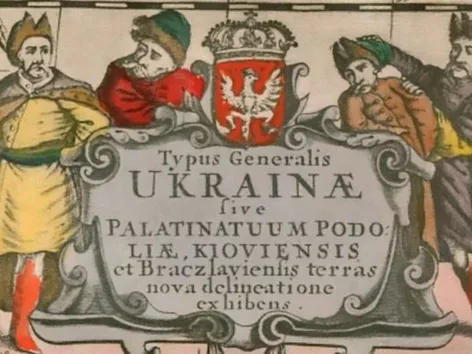
Zum ersten Mal erschien der Name "Ukraine" in den Annalen "Die Geschichte vergangener Jahre" im Jahr 1187, aber unser Staat wurde offiziell erst im 19. Jahrhundert so genannt. Erfahren Sie, woher der Name "Ukraine" stammt und welche Mythen die russische Propaganda darum spinnt

The history of Ukraine is very old, interesting and filled with many events. However, the appearance of its name can be singled out as a separate page in the formation of the state.
How did the name "Ukraine" come about? What is its meaning? We talk about the origin and formation of the name "Ukraine" below.
Where does the name "Ukraine" come from?
The origin of the name "Ukraine" has long attracted the attention of scientists, but there is still no single explanation. Some researchers associated it with the words kray, that is, "the farthest part of the territory from the center", others - with the nouns kray, country in the sense of "native region, own country, native land." There is another view, according to which the name Ukraine supposedly comes from the verb украяти (to cut off), that is, the original meaning of this name is "a piece of land, cut off (cut off) from the whole, which later itself became a whole (a separate country)".
The version that connects the name Ukraine with the words "land", "country" should be considered the most probable and convincing. The noun edge with the meaning "segment, piece; a piece of land" was still in the common Slavic language and is now known in many Slavic languages. Since the Slavic tribes from time immemorial had their territories, which were mostly separated by natural boundaries - rivers, forests, swamps, salt marshes (therefore, there was no mixture of tribes), the ancient Slavic word kray "a segment, a piece of land" acquired a new meaning - "a territory belonging to a tribe ".
The first appearance of the name "Ukraine"
"Ukraine" is the only name of the territory inhabited by the Ukrainian people. For the first time, the word appeared in the Ipatiev list "Tales of Bygone Years", where the chronicler tells about the death of Prince Volodymyr Hlibovych of Pereyaslav in 1187: "And all the people of Pereyaslav wept for him... Ukraine tried hard for him."

A passage from the Peresopnytsk Gospel (1556) in which the word "Ukraine" occurs
"Ukraine" during the time of the Cossacks
With the development of the Cossack region in the 16th century, the name "country" became the geographical name of the Cossack territory, which covered the vast expanses of the Dnieper region - Pravoberezhna and Livoberezhna.
The name "Ukraine" gained special political significance during the Khmelnytskyi period. Although the official name of the Cossack-Hetman State of the 17th-18th centuries was "Zaporozhian Army" (with various variants), its territory was "Cossack land", which was usually called Ukraine in both Ukrainian and Polish practice.

Map of "European Tataria or Little Tataria" by the Italian Giacomo Cantelli da Vignola (1688). Transnistria is shown as "Ukraine or the land of the Zaporizhzhya Cossacks"
That is why the names Ukraine, Ukrainian, Ukrainian people were increasingly used in the political and cultural life of the Hetmanship. We meet them in acts and documents of B. Khmelnytskyi, I. Vyhovskyi, P. Doroshenko, I. Samoilovych, I. Mazepa, P. Orlyk. Elder Doroshenko in a letter to Zaporizhzhia in 1671 wrote about "all of Ukraine", "our Ukrainian people", "Ukr. cities" etc.
Hetman Pylyp Orlyk fondly used this name in official acts and in private letters. In the 1711 treaty with the Crimea, Orlyk is titled "dux Ukrainae".
This name became known and popular in Western Europe also thanks to the second edition of the "Description d'Ukrainie" by the military engineer Guillaume Levasseur de Beauplan in 1661.
After the Andrus Agreement of 1667 and the division of Ukraine between Moscow and Poland, the names "Sogobichna" and "Togobichna" Ukraine appear, and for the Left Bank "Little russian Ukraine".
Although the name "Ukraine" was widely used in the Hetmanate in the 17th and 18th centuries, outside its borders, it did not become the official name of the Ukrainian state, because it continued to be "Zaporozhian Army" or, in the parts that were under russian influence, "Little russia".
Visit Ukraine on social media: Telegram | YouTube | Instagram | Facebook | Twitter | TikTok
The name "Ukraine" in the 19th-20th centuries
As soon as the majority of Ukrainian lands were united in the 19th century, the entire territory of the state received the name "Ukraine".
Since the second half of the 19th century, the name "Ukraine" has been used in Ukrainian civil and private life, defining the entire territory of the Ukrainian people and eliminating all other names (in particular, Little russia).
After the proclamation of the Ukrainian People's Republic, the names Ukraine and the Ukrainian people are finally established as the official names of the Ukrainian state.
Under Soviet rule, Ukraine was called the Ukrainian Soviet Socialist Republic, and since January 31, 1937, the Ukrainian Soviet Socialist Republic.
With the declaration of Independence in 1991, the name Ukraine was fixed for the Ukrainian state.
Myths about the name "Ukraine"
In russia, a popular version is that the name "Ukraine" means "outskirts of the russian empire", but this is not true at all. After all, we see from history that regardless of its origin, the word Ukraine belonged to the Cossack state, which was created by Bohdan Khmelnitsky. That is, such a name was applied to Ukraine long before the state became part of the russian empire.
Of course, it was not a "fringe" of the russian empire and all the time claimed full state independence. It was because of this that the use of the word Ukraine was banned in tsarist russia. And only when it became clear to the royal officials that this word cannot be destroyed and erased from the memory of Ukrainians, it was decided to discredit it. russian propaganda began to explain the name of our region, Ukraine, as "outskirts of russia", that is, they put a derogatory and uncharacteristic meaning into this word.
So, the name "Ukraine" has a rich history and it appeared long before the appearance of the russian empire. Therefore, the myth spread by the russian federation about the emergence of the name "Ukraine" has nothing to do with reality.
We will remind you! How Muscovy tried to appropriate Kievan Rus, we told in this article.
You may be interested in:
Visit Ukraine Donation - make a good deed and an important contribution to the Victory of Ukraine;
Visit Ukraine Tours - the largest online database of tours to Ukraine for every taste;
Visit Ukraine Merch - choose patriotic clothing and accessories with worldwide delivery;
Visit Ukraine News - get the latest news and updates in our Telegram channel;
Cooperation - cooperation and advertising integrations with Visit Ukraine and Visit World projects.
© 2018-2024, Visit Ukraine. Use, copying or reprinting of materials on this site is permitted only with a link (hyperlink for online publications) to Visit Ukraine.
All rights reserved.
Recommended articles
3 min
Beliebt
Bogen der Freundschaft der Völker in Kiew: Geschichte und Gegenwart
Die Streitigkeiten über das Denkmal-Bogen im Zentrum von Kiew dauern seit Beginn der russischen Aggression im Jahr 2014 an. Derzeit wird das Denkmal unter dem Bogen, der "Freundschaft der Völker" genannt wurde und umgangssprachlich "das Joch" genannt wird, abgebaut. Erfahren Sie mehr über die Geschichte des Denkmals und was jetzt mit ihm passiert.
 Yuliia Dyka
06 Mai. 2024
More details2 min
Kultur
Jahrhundertealtes Erbe: Die ältesten Städte der Ukraine mit einer tausendjährigen Geschichte
Einige Städte in der Ukraine wurden zu einer Zeit gegründet, als der größte Teil des Kontinents von nomadischen Stämmen bewohnt war. Und sie haben die Geschichte der Entstehung der Ukraine mit eigenen Augen gesehen. Erfahren Sie mehr über die ältesten Städte der Ukraine, die heute über 1000 Jahre alt sind
Yuliia Dyka
17 Sep. 2024
More details2 min
Ereignisse
Verfassungstag 2024: Wird es einen Feiertag geben und wohin in Kiew?
Diese Woche wird die Ukraine den Verfassungstag feiern. Im Jahr 2024 wird das Hauptgesetzeswerk des Landes 28 Jahre alt. Erfahren Sie, ob es ein Feiertag sein wird und wie Sie den 28. Juni in Kiew verbringen können, indem Sie kostenlose Touren, Museen, Theateraufführungen und andere kulturelle Veranstaltungen genießen.
Yuliia Dyka
24 Jun. 2024
More details1 min
Ereignisse
Ihre Kreativität ist unsere Inspiration: Nehmen Sie am Wettbewerb von Visit Ukraine teil!
Erstellen Sie einzigartige Kunst für das Touristeninformationszentrum von Visit Ukraine und verwandeln Sie Ihre Arbeit mit unserer Unterstützung in Realität. Erfahren Sie, wie Sie Teil unseres Raums in der Hauptstadt der Ukraine werden können
Yuliia Dyka
11 Jul. 2024
More details