


.gif)
Polish language certification exam: a guide for Ukrainians who want to confirm their level

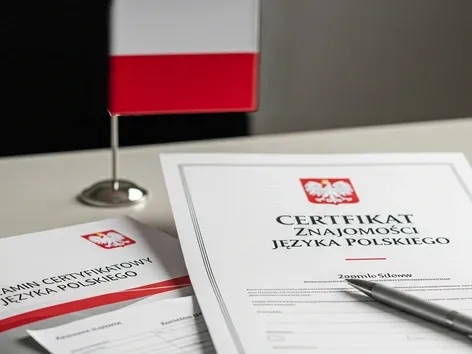
The Polish language certification exam opens the way to education, work, and citizenship in Poland. Find out how to register, what levels exist, and how to prepare for the test to obtain an official certificate of Polish language proficiency

Obtaining a certificate confirming knowledge of the Polish language is an important step for those who plan to build a life, study, or work in Poland. The Polish language exam (Państwowe egzaminy certyfikate języka polskiego jako obcego) is an official confirmation of language proficiency and a prerequisite for obtaining citizenship or admission to a university.
Why do you need a Polish language certificate?
The certification exam is the only official document confirming knowledge of the Polish language in Poland. As noted by the in-poland portal, it is required in three main cases:
● when applying for Polish citizenship;
● when applying for a job or confirming qualifications in Polish companies;
● when enrolling in Polish universities or studying in Polish-language programs.
In addition, the certificate is a strong argument for employers, government agencies, and visa centers.
If you plan to legalize your stay or apply for a residence permit in Poland, we recommend that you consult with migration lawyers at Visit Ukraine in advance. They will help you assess your chances, prepare your documents correctly, and avoid common mistakes related to the recognition of certificates or confirmation of language proficiency.

Certification exam levels
The exam covers six levels of Polish language proficiency as defined by the Council of Europe. Each level corresponds to a specific degree of language proficiency, from basic to advanced.
1. A1 — beginner level. Minimum knowledge for communication in everyday situations: introducing yourself, your family, describing your place of residence, etc.
2. A2 — elementary level. Allows you to hold simple conversations about work, shopping, family, or your surroundings.
3. B1 — intermediate level. Sufficient for understanding basic topics in conversations and texts, communicating while traveling or at work.
4. B2 — advanced level. Allows you to freely maintain a conversation with native speakers, express reasoned opinions, and write texts on various topics.
5. C1 — high level. Suitable for studying, working in a professional environment, conducting negotiations, and understanding complex texts.
6. C2 — proficiency level. Almost complete linguistic competence — the ability to understand any text, communicate freely, and accurately formulate thoughts even in complex situations.
The level of the exam should be chosen based on the purpose: for example, level B1 is usually sufficient for citizenship, and B2 or C1 is sufficient for work or study.
Don't want to miss important updates and useful articles? Subscribe to our weekly newsletter!
How to register for the exam
Registration for the exam begins several months before the exam date. The number of places is limited, so registration closes quickly.
Registration steps
1. Go to the website www.certificatspolski.pl.
2. Fill out the initial form with your contact details (first name, last name, e-mail).
3. You will receive a link to an extended questionnaire by e-mail, where you will need to provide your passport details, PESEL, address, date of birth, and postal code.
4. After confirmation, pay the participation fee.
Payment and confirmation of participation
The cost of the exam depends on the level, but on average it is between €150 and €200. After payment, the participant will receive confirmation of enrollment. Without this document, participation in the test is not possible.
Many participants note that it is best to check the status of your application via official email or your personal account on the website. If you do not receive confirmation, you should contact the organizers — sometimes emails end up in spam.
How the certification exam works
The exam consists of several parts:
● listening comprehension (understanding spoken language),
● reading comprehension (analysis of written texts),
● grammar and vocabulary,
● writing (creating short texts or essays),
● oral part (conversation with the examiner).
The duration depends on the level — on average, from 3 to 5 hours. The results will be announced no less than 3 weeks after the exam.
Life hacks from those who have already taken the exam
1. Prepare your documents in advance. The organizers are very strict about IDs.
2. Check your email before the exam. The place and time may change.
3. Study current topics. Questions often relate to current social issues, so reading Polish news will help.
4. Speak confidently. During the oral part, not only accuracy but also spontaneity of speech is assessed.
If you are taking the exam to obtain a residence permit or citizenship, consultation with a lawyer on migration law at Visit Ukraine will help you to correctly formalize the results, legalize the certificate, and prepare a package of documents for submission to the office.
We remind you! Poland plans to tighten the conditions for foreigners to obtain citizenship. Read about how many years you now need to live in the country to be eligible for citizenship.
Photo: eurostudy.info
Want to know more? Read the latest news and useful materials about Ukraine and the world in the News section.
Our recommendation for a safe and comfortable trip:
Visit Ukraine Insurance - insurance for a safe stay abroad without unnecessary expenses;
Green Card - compulsory car insurance for traveling abroad;
Visit Ukraine Tickets - book tickets for buses, trains, and airplanes to/from Ukraine and between cities around the world;
Private Lawyer service - professional legal support on visa and migration issues;
Visit Ukraine Merch - buy patriotic clothing and accessories with worldwide delivery.
© 2018-2025, Visit Ukraine. Use, copying or reprinting of materials on this site is permitted only with a link (hyperlink for online publications) to Visit Ukraine.
All rights reserved.
Recommended articles
2 min
For refugees
Poland to launch new electronic social benefits system for Ukrainians in 2026
Poland is preparing for important changes in the social support system for Ukrainians. Soon, the application process will become fully digital, which will improve control and transparency of payments. Learn more about the new electronic system, which will be launched in 2026
Yuliia Dyka
13 Sep. 2025
More details2 min
For refugees
Extradition from Poland to Ukraine: changes in practice and procedures
The number of extraditions to Ukraine has increased in Poland, indicating a change in the approach of European courts and a gradual strengthening of legal cooperation between states. Despite the state of war, the practice of extradition continues to develop, although each case is considered with particular care. Find out on what grounds decisions are made, how the procedure works, and when deportation is used instead of extradition
Yuliia Dyka
25 Sep. 2025
More details2 min
For refugees
Changes for Ukrainians in Poland from October 1: new rules for submitting documents for a CUKR card
The rules for legalization for Ukrainians in Poland are changing. Find out when you can submit documents for a CUKR card, how long your legal stay will last, and what new requirements will apply in 2025–2026
Yuliia Dyka
02 Oct. 2025
More details1 min
Travel
Going to Poland? Here is a list of things that will surprise you
Poland can surprise even those who consider it a ‘neighbour with no secrets.’ Here, traditions coexist with modernity, order reigns in the streets, and you can buy borscht from coffee vending machines. Discover the features that impress travellers and make this country so unique
Yuliia Dyka
07 Oct. 2025
More details