Icon

3 min

07 oct.. 2024

7841

Forteresse de Tustan : un monument archéologique unique, centre administratif, bureau de douane et installation de défense

Explore Ukraine
Popular
Travel
Tourists in Ukraine
Ukraine
Forteresse de Tustan : un monument archéologique unique, centre administratif, bureau de douane et installation de défense

Des dizaines de châteaux en ruine ont subsisté sur le territoire de l'Ukraine depuis le siècle dernier. Les majestueuses ruines se souviennent de l'histoire et accueillent des milliers de visiteurs chaque année. Tustan n'est pas la seule forteresse, mais c'est l'une des plus célèbres. Elle possède les pittoresques montagnes des Beskides, des pétroglyphes sur les murs, les vestiges d'une route de douane, et bien plus encore. Découvrez ce pour quoi Tustan est connue et comment elle vit, quelles excursions elle invite les visiteurs à faire, et quels itinéraires sont les meilleurs pour les conducteurs et ceux qui voyagent en transports en commun

Visites de l'Ukraine indestructible. En savoir plus sur le site web
CHOISIR UNE VISITE

For almost 1000 years, the Tustan fortress has been impressing with its grandeur and power. At first, it was used by Polish conquerors, later by salt traders, and even now, when Tustan lies in ruins, it continues to attract and interest people from all over the world. Yes, it is not only Ukrainians who travel along the paths of ancient defences. Tustan is a unique archaeological and architectural monument, which has no analogues in Europe. The thing is that the fortress is a combination of wood and Carpathian rocks: the rocks serve as the walls of the structure. Read more about what Tustan is known for, how it lives now, what excursions it offers and what routes it is located on in the material by Visit Ukraine.

What do we know about the Tustan fortress?


Tustan is best known as a fortress and a border customs checkpoint of the 12th-16th centuries. According to You Tube blogger Romko Travel, its name comes from the exclamation ‘stop here’, which was used to stop travellers to pay customs duties. However, scientists consider another version: the name comes from the name of the founder of the settlement and means ‘strong, sturdy, brave, persistent’. The Old Rus rock defence complex has not survived to this day, and its remains are located in the Ukrainian Carpathians (Eastern Beskydy region) and Stryi district of Lviv region near the town of Urych. The remains of the fortification are located on the territory of the Pidhorodtsi forestry. Since 1994, the fortress has been a part of the Tustan State Historical and Cultural Reserve.

The castle has the status of an archaeological monument of national importance and the status of a natural monument of local importance. While everything is clear with the second status, the first one raises a question: what contribution did Tustan make to archaeological research? The answer will also be given by You Tube blogger Romko Travel, who says that ancient petroglyphs - carved rock images - were found on the rocks of Tustan. The latest research of the Tustan petroglyphs was carried out in 2015 by local experts. In addition, the results of archaeological excavations, which began with the research of Mikhail Rozhko in 1971, confirm that Tustan is unique in Europe.

The materials used for construction were stone and wood, and the first mention of Tustan dates back to 1940.

Photo: Tustan

History of the fortress on the salt route


The Tustan fortress was a volost centre and customs office. It was located on the salt route from Drohobych to Zakarpattia/Western Europe. The castle existed and functioned until 1565 - this is the latest mention of the fortress.

It is also known that Tustan was the main customs office on the Lviv-Veretskyi Pass route: duties were paid for the transport of salt and cattle.

The earliest written mention of Tustan is found in the work of the Polish chronicler Janko of Czarnkow, a sub-chancellor of the Polish king Casimir III. From his chronicle we understand that in the period of 1363-1384 the town was included in the list of those fortified by the Polish king.

But Jan Dugłosz, a follower of Janko from Czarnkow, says that Tustan was captured by Casimir III in 1340. Most likely, it was January, because according to tradition, it was the ‘birthday of John the Baptist’, which is mentioned in the chronicle as the day the campaign began.

Tustan existed as a customs office, as an administrative centre, as a military fortification, and as an estate of Polish magnates until the 16th century:

- economic - Central European countries are developing their own salt deposits, so the trade flow is decreasing;

- political - the destabilisation of the situation between Poland and Hungary caused the borders to shift eastwards, so Tustan was no longer a military fortress;

- military - the development of new tactics and strategies of war required the improvement of Tustan's defences, for which the fortress was not ready.

What can you see in Tustan?


Tour of the Tustan cliffs


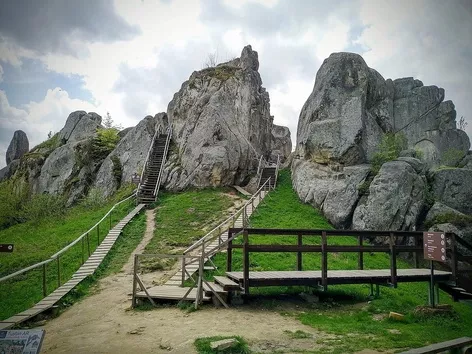
The Tustan fortress has a unique architectural design: the rocks were used as walls, and all the necessary elements were completed with wood. So Tustan is an example of an extraordinary architectural combination.

The route involves climbing around the rocks to the cubicle, from where you can see the Skole Beskydy and the surrounding villages in the valleys. All the ruins of the former fortress are fully visible from here. And you can see how it looked in its heyday on a 3D model based on Mykhailo Rozhko's graphic model (created during the expeditions of 1971-2004).

During the tour, you can see petroglyphs with your own eyes, including carvings of a wolf chasing a moose, a horse, a moose, axes and crosses. The petroglyphs are located on the northeastern side of the Gulka rock in the Pishchyna ur.

When descending from the cubicle, you can see a deep well that supplied the fortress with water during the siege and walk along the ancient trade route that was used to transport salt.

Opening hours:


- November - March: from 9:30 to 17:00;

- April - October: from 10:00 to 18:00

Ticket price:


- for an adult - 150 UAH;

- for privileged categories (children, students, pensioners) - 75 UAH.

Free admission:


- for children of preschool age;

- for children from orphanages and boarding schools;

- for disabled people of groups I and II;

- for people with childhood disabilities;

- for participants and veterans of the Second World War;

- for participants of the anti-terrorist operation;

- for participants of the Joint Forces Operation (JFO);

- for museum workers who carry out inspections according to international categories;

- for participants in the liquidation of the consequences of the Chornobyl nuclear power plant (group I);

- for accompanying persons of an organised group of schoolchildren or students (more than 10 people).

The ticket price also includes a visit to the Tustani Museum and the Local History Centre ‘House in Hluboky’.

Visit to the Tustan Museum


All the treasures found by archaeologists during the excavations of the fortress are available in the Tustan Museum - originals and copies are presented here, which help to imagine the life and defensive features of the fortress. A separate part of the exhibition is a reconstructed collection of 16th-century tiles found during the excavations. Another exhibition is the 13th-century voivode's room.

The museum was opened in 1997, and in 2017, a modern exhibition with projection equipment and models was opened to help recreate the life of the fortress.

The House in Gluboky


These territories have long been inhabited by the Boyko ethnic group. And the town of Urych, which is close to the Tustan fortress, has preserved several authentic huts and wooden wells of a specifically Boyko style.

One of these huts was restored by the reserve and now houses the Cultural and Community Centre of the village and the House in Glubokym Local History Centre. The centre regularly hosts masterclasses in folk crafts and meetings with the reserve's staff.

Since 2016, there has been an exhibition ‘Trash? The History of Urych in Objects and Images’, which collects ethnographic materials from almost every house in the village. Here you can also see videos of local residents' testimonies about the UPA, the insurgency and Ukraine's path to independence.

Since 2018, the Centre has been a participant in the project ‘World of Carpathian Rosettes - measures to preserve the uniqueness of the Carpathian culture’ with the financial support of the European Union, which involves the rebuilding and reconstruction of the building.

What festivals does Tustan offer to tourists?


We offer you the following:

- The Tustan Ukrainian Medieval Culture Camp, which takes place for 3 days every August;

- The Boyko Festival, held annually at the House in Glubokym Local History Centre, which makes Boyko culture and history known throughout Ukraine and the world - it is part of the World of Carpathian Rosettes project.


Visit Ukraine on social media: Telegram | YouTube | Instagram | Facebook | Twitter | TikTok


How to get to Tustan?


Tustan is located in the Lviv region, so we build routes from two points: Kyiv and Lviv.


Photo: Tustan


Route from Lviv to Tustan


By car: the road from Lviv to Urych is 100 km, if you go through Skhidnytsia - 110 km.

By bus: routes to Tustan (Urych) run from Stryi, Skhidnytsia, Truskavets and Skole.

You canfind out the current bus schedule, agree on the best route and book tickets on the Visit Ukraine portal.

The route from Kyiv to Tustan


By car: the route is 118 km along the Kyiv - Chop highway (after the village of Verkhnye Syniovydne or after the village of Dubyna, turn right to Urych)

By bus: you can go from Kyiv to Ivano-Frankivsk (buses depart from the Kyiv bus station in the direction of Kyiv - Halych), and from there (from the bus station) there are direct buses to Tustan.

You can learnmore about Tustan Fortress in a special tour from Visit Ukraine. Follow the link to book it.

Photo: Funtime

To make your trip comfortable and leave an incredible impression, entrust its organisation to specialists. Visit Ukraine specialists will help you organise transfers, book tickets and accommodation, arrange medical insurance, and provide guide support. Contact us on Telegram or WhatsApp.


Want to know more? Read the latest news and useful materials about Ukraine and the world in the News section.


We recommend purchasing it for a safe and comfortable trip to Ukraine: 


Visit Ukraine Insurance - insurance covering military risks for entry and travel in Ukraine;
Visit Ukraine Car Insurance - car insurance with extended coverage in Ukraine;
Visit Ukraine Legal advice - comprehensive legal support on entry to Ukraine;

Visit Ukraine Legal advice – comprehensive legal support on entry to Ukraine;
Visit Ukraine Tickets – bus and train tickets to/from Ukraine;

Visit Ukraine Tours – the largest online database of tours to Ukraine for every taste;

Visit Ukraine Hotels – hotels for a comfortable stay in Ukraine;

Visit Ukraine Merch – patriotic clothing and accessories with worldwide delivery.


© 2018-2024, Visit Ukraine. Use, copying or reprinting of materials on this site is permitted only with a link (hyperlink for online publications) to Visit Ukraine.

All rights reserved.

Frequantly
asked questions
Pourquoi la forteresse de Tustan est-elle célèbre ?
Tustan est surtout connue comme une forteresse et un poste de douane frontalier des XIIe-XVIe siècles.
D'où vient le nom de la forteresse de Tustan ?
Où se trouve la forteresse de Tustan en Ukraine ?
Pourquoi Tustan a-t-elle le statut de site archéologique d'importance nationale ?
Quand Tustan a-t-elle été mentionnée pour la première fois dans les chroniques ?

Recommended articles

3 min

Explore Ukraine Bakota incroyable : quel est cet endroit, que pouvez-vous y voir et comment y accéder ?
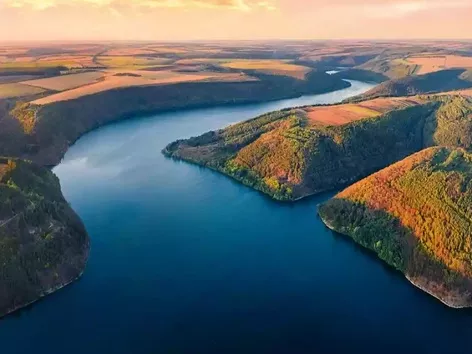
Bakota incroyable : quel est cet endroit, que pouvez-vous y voir et comment y accéder ?

La fascinante et inhabituelle baie de Bakot attire des milliers de touristes chaque année - non seulement d'Ukraine mais aussi du monde entier. Elle est unique - en tant que site touristique, hydrologique et géographique. Découvrez quelle est l'histoire de l'ancienne ville, comment elle 'vit' maintenant, ce que vous pouvez y voir et comment vous pouvez y accéder

26 sept.. 2024

More details

3 min

Explore Ukraine Château de Mukachevo Palanok : un géant puissant de la Transcarpatie

Château de Mukachevo Palanok : un géant puissant de la Transcarpatie

L'ouest de l'Ukraine est célèbre pour ses fortifications. Des dizaines de châteaux, à la fois en activité et en ruine, attirent des touristes du monde entier. Une architecture intéressante, des légendes effrayantes et des secrets historiques les entourent. Le plus célèbre en Zakarpattia est le château de Mukachevo, également connu sous le nom de château de Palanok. Découvrez son histoire, ses lieux intéressants, ses légendes et ses secrets dans le matériel de Visit Ukraine

01 oct.. 2024

More details

4 min

Explore Ukraine L'Ukraine est-elle une perle touristique de l'Europe ? Pourquoi tout le monde devrait venir ici au moins une fois dans sa vie

L'Ukraine est-elle une perle touristique de l'Europe ? Pourquoi tout le monde devrait venir ici au moins une fois dans sa vie

L'Ukraine est un grand pays spacieux, indomptable, beau et tout simplement le meilleur pays au cœur de l'Europe. Elle est connue pour son patrimoine historique et son histoire, qui se crée sous nos yeux ; pour ses paysages naturels inégalés et ses opportunités touristiques uniques que aucun autre pays ne peut offrir. En temps de guerre, ce pays devient intéressant pour encore plus de voyageurs qui souhaitent vivre quelque chose de nouveau, de réel, d'important et de sincère en voyageant. Découvrez pourquoi l'Ukraine a toutes les chances de devenir un leader touristique en Europe et pourquoi vous devriez la visiter dès maintenant

03 oct.. 2024

More details

3 min

Explore Ukraine Suisse ukrainienne : qu'est-ce qui impressionne dans le canyon de Butsky ?

Suisse ukrainienne : qu'est-ce qui impressionne dans le canyon de Butsky ?

Le canyon de Buky est à juste titre appelé la Suisse ukrainienne. Des rochers hauts, âgés de plus de 2 milliards d'années, forment un endroit pittoresque qui attire des touristes d'Ukraine et du monde entier. Découvrez pourquoi Buky est intéressant pour les touristes, ce que vous pouvez voir et goûter ici, comment y arriver et quels faits intéressants vous devriez connaître

06 oct.. 2024

More details