


.gif)
Gestohlene Geschichte der Ukraine: 12 archäologische Schätze, die von Russland entwendet wurden

- Golden comb from the Solokha mound
- A zoomorphic fibula from the first Mikhalkov treasure
- Gold earrings from Olbia
- Kropyvnytskyi rhyton
- Ivan Mazepa's cannon "Lion"
- Mosaics and frescoes from the destroyed St. Michael's Cathedral
- An ornithomorphic gold plate and a sword from the Cast Tomb
- Coins from Khotyn
- A silver jug depicting a dog-bird and the tree of life
- Stela Leoxa from the Kherson Museum
- A man from the Black Grave
- Helmet and iron mask from the Kyiv region
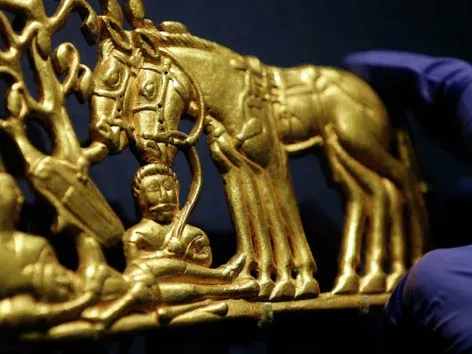
Auf dem Gebiet der modernen Ukraine lebten antike Völker mit einer entwickelten Kultur, und viele wichtige historische Ereignisse fanden statt. Doch selbst heute zeigt Russland weiterhin seine imperiale Arroganz, indem es ukrainische Denkmäler aneignet. Erfahren Sie mehr über 12 archäologische Schätze, die von Russland entwendet wurden

Ukraine is rich in cultural monuments and archaeological finds, because different peoples with developed cultures lived on its lands. Such treasures have always been a tasty prey for invaders. Therefore, russia, which still considers it normal to claim its rights to everything Ukrainian, loots museums or destroys monuments.
After the annexation of Crimea in 2014, russian archaeologists began to explore these territories and museums and export their findings to russia. After the full-scale invasion, the aggressor "evacuated" collections from museums in the occupied territories.
The brutal robberies of museums reminded us of the times of the Russian Empire, which systematically exported jewelry from Ukrainian territory. For example, since the 19th century, archaeological finds were examined by the Imperial Archaeological Commission. Its decision determined where the jewel would be located in the future, so it is not surprising that the museums of Moscow and St. Petersburg were replenished.
The Ukrainian Association of Archaeologists has published a list of jewelry appropriated by russia over the past centuries. Here are 12 treasures stolen by russians.
Golden comb from the Solokha mound
This find dates back to the late 5th - early 4th century BC. The comb was found in the Solokha mound near the village of Velyka Znamianka, Zaporizhzhia region. The village is currently occupied.
The golden crest was made by craftsmen commissioned by the Scythian aristocracy. However, today Ukrainians will not see this work of goldsmithing in national museums. The crest is part of the collection of the russian Hermitage Museum, and its place of origin is indicated as "Northern Black Sea" or "Prydniprovia."
A zoomorphic fibula from the first Mikhalkov treasure
A fibula is a clasp that serves as a decoration. It belongs to the treasures of the Halstatt culture (date of creation: 8th-7th centuries BC). The fibula was found in 1878 in the village of Mikhalkiv in the Ternopil region. Twenty years later, archaeologists found another treasure in this village - the land was so rich.
Some of the treasures of Mykhailiv, including the fibula, were taken to Moscow in 1940 after the Soviet occupation of Lviv. According to experts, the jewelry is still there.
Gold earrings from Olbia
Olbia was one of the most important cities of the ancient Greeks in the Northern Black Sea region, so archaeologists have conducted many excavations on the territory of the polis. The first archaeological research was carried out in 1901, and since then Olbia's treasures have been transferred to museums in Moscow and St. Petersburg, and sometimes to Odesa and Mykolaiv.
Among the precious jewelry were gold earrings dating back to the sixth century B.C. They were found in 1913 and taken away by the imperial center. The gold jewelry, according to theory, belonged to a wealthy resident of the ancient city.
It should be added that in addition to the earrings, at least five similar jewelry pieces found in the Olbia necropolis were taken to the Hermitage. They are now in the museum's collections.
Kropyvnytskyi rhyton
A rhyton is a vessel in the shape of a curved horn, which was used for ritual libations or drinking. The antique vessel was found in 1746 in the Kropyvianske Sotnia of the Pereiaslav Regiment of the Hetmanate.
According to archaeologists, the rhyton was made of silver and gilded in the fourth century BC in what is now Bulgaria.
This discovery was also stolen from Ukrainians to add to the Hermitage collection. The vessel continues to be kept in a russian museum under the name Poltava Riton.
Ivan Mazepa's cannon "Lion"
The double-barreled cannon was made of bronze by Ukrainian craftsman Karp Balashevych in 1705 in Hlukhiv, Sumy region. At the request of Hetman Mazepa, it was decorated with ornaments and heraldic signs of the hetman.
After the defeat of the Hetman's army, russian troops plundered cities and appropriated trophies. Cossack cannons were the achievements that the imperial "nobles" adored, so numerous of kleynodes were stolen.
In Soviet times, the Ukrainian SSR tried to return the stolen valuables. However, the attempts failed, and the Lion cannon is still kept in the museum in the Kremlin.
Mosaics and frescoes from the destroyed St. Michael's Cathedral
St. Michael's Cathedral, which is one of the symbols of Kyiv, was built during the reign of Prince Sviatopolk Izyaslavych in 1108-1113. Unfortunately, the original building has not survived to this day. The cathedral was blown up by the Soviets in 1937. After that, some of the surviving elements were exhibited at the State Ukrainian Museum in Kyiv. Among them were mosaics, frescoes, and slate reliefs.
After some time, Pimon Rudiakov, who worked as the museum's director, was shot because of accusations of Ukrainian nationalism, and the exposition was divided among other institutions. Some of it was transferred to St. Sophia Cathedral, while another part was sent to Moscow and never returned.
Although St. Michael's Cathedral has been rebuilt and some of the authentic mosaics are preserved in Ukraine, most of the frescoes have been lost. In addition to the fact that russians are not going to return the seized monuments, they boast of Ukrainian treasures. For example, the Tretyakov Gallery is exhibiting monumental art from St. Michael's Monastery under the title "Ancient Russian Art. The Pre-Mongolian Period".
Visit Ukraine on social media: Telegram | YouTube | Instagram | Facebook | Twitter | TikTok
An ornithomorphic gold plate and a sword from the Cast Tomb
Periodic excavations in the steppes of Ukraine began in the eighth century, and it was then that russia began to appropriate Ukrainian treasures. The Cast Grave or Melhunov barrow provided archaeologists with material for researching the Scythians. Incredible antiquities were found in the mound, including 17 ornithomorphic gold plates and a sword. These artifacts date back to the VII century BC.
Coins from Khotyn
In the town of Khotyn, Chernivtsi region, an ordinary citizen found a real treasure in 1889 - from 1000 to 1600 coins. Most of them were taken to the Hermitage Museum for study, where they remain today.
The Ukrainian side has repeatedly asked the museum's management to examine the artifacts, but all requests have been denied.
A silver jug depicting a dog-bird and the tree of life
Another treasure in the Hermitage is exhibited without mentioning Ukraine as its place of origin. This product of Persian masters of the third to seventh centuries came to Ukrainian lands through trade agreements, so it is extremely rare and valuable.
The silver jug was found by peasants in 1823 in the Luhansk region among a number of other things.
Stela Leoxa from the Kherson Museum
This artifact was stolen not so long ago, in October 2022, when the invaders decided to "evacuate" the Kherson Regional Museum. Currently, no one knows where the historical monument is.
If we recall the history of the stele, it should be added that it was created in the fifth century BC and transferred to the Kherson Museum in 1895. The artifact was found by archaeologists in Olbia (modern Mykolaiv region). As for the images: the marble slab contains a figure of a warrior leaning on a spear and another figure in a Scythian costume.
A man from the Black Grave
Because the Black Tomb contained artifacts from the times of Kievan Rus, it was of particular importance to russians. The desire to appropriate the "princely era" prompted the theft.
This figurine is unique not only for Ukraine but for the whole world. Four other similar figurines are of Scandinavian origin, so there is a theory that they were used for a board game.
Helmet and iron mask from the Kyiv region
The Black Klobuchs were an association of Pechenegs, Torks, Berendeys, and Kovuys who, with the permission of the prince of Kievan Rus, lived in the forest-steppe part of the Kyiv region. This group left behind numerous antiquities, especially weapons and armor, which were found during excavations of the mounds.
The mounds of the Black Clobbermen were investigated in the late nineteenth century. Unfortunately, the iron helmet and mask, along with most of the finds, were taken by russian scientists for the needs of their museums. Since 2017, the iron mask from the Kyiv region has been shown to visitors of the Hermitage, indicating the place of discovery of the treasure as russia, little russia, or the Dnipro region.
The culture of the Black Clobber has hardly been studied, as archaeologists have found few artifacts. And what was dug up was taken to the imperial museums of russia.
We do not lose hope of returning all the stolen monuments, because in the end the criminals are responsible for their actions.
We remind you! Earlier we told you that the literary achievements of Ukrainian writers are not limited to the borders of Ukraine, because their books find their readers all over the world. Learn more about the authors who have made a significant contribution to the popularization of Ukrainian literature in our article.
You may be interested in:
Visit Ukraine Donation - make a good deed and an important contribution to the Victory of Ukraine;
Visit Ukraine Tours - the largest online database of tours to Ukraine for every taste;
Visit Ukraine Merch - choose patriotic clothing and accessories with worldwide delivery;
Visit Ukraine News - get the latest news and updates in our Telegram channel;
Cooperation - cooperation and advertising integrations with Visit Ukraine and Visit World projects.
Recommended articles
1 min
Krieg
Das Innenministerium der Ukraine hat fast vollständig Sturmbrigaden für offensive Operationen gebildet. Erfahren Sie mehr darüber, warum diese Einheiten geschaffen werden und welche Aufgaben sie erfüllen werden
Yuliia Dyka
03 Jun. 2023
More details1 min
Beliebt
8 herausragende ukrainische Athleten
Die Ukraine hat eine Reihe herausragender Athleten, die das Land auf der internationalen Sportbühne berühmt gemacht haben. Diese talentierten Athleten beeindrucken nicht nur mit ihren Leistungen, sondern dienen auch als Vorbilder für Mut, Durchhaltevermögen und Professionalität
Yuliia Dyka
04 Jun. 2023
More details2 min
Der Weg zum Sieg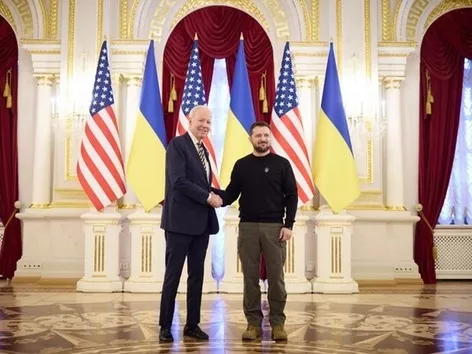
US-Hilfe für die Ukraine: Warum Bidens Fall in Colorado die ukrainische Gesellschaft erschütterte
Die Vereinigten Staaten sind ein strategisch wichtiger Partner der Ukraine, da ihre militärische und finanzielle Unterstützung auf mehrere zehn Milliarden Dollar geschätzt wird. Erfahren Sie, warum die Ereignisse in Colorado die Ukrainer nervös gemacht haben und warum Joe Bidens Gesundheit für die Ukraine wichtig ist
Yuliia Dyka
04 Jun. 2023
More details1 min
Krieg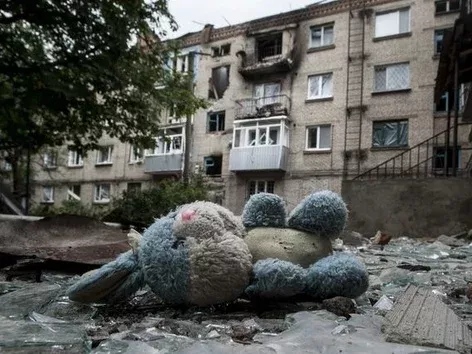
Am 4. Juni gedenkt die Welt des Internationalen Tags der unschuldigen Kinderopfer der Aggression. Ukraine ehrt jedoch das Andenken an die Kinder, die infolge der bewaffneten Aggression Russlands gestorben sind. Erfahren Sie, wie viele junge Ukrainer gestorben sind und welche Regionen in Bezug auf Kinderopfer während des Krieges führend sind
Yuliia Dyka
04 Jun. 2023
More details